
EasyRoutes Workflows / Autopilot
Note: Access to Autopilot workflows requires an EasyRoutes Premium or Enterprise subscription. EasyRoutes Autopilot is under active development. If you run into any issues while interacting with Autopilot workflows, or have suggestions for how this feature could better support your delivery planning needs, please let us know.
EasyRoutes' Autopilot feature allows users to set custom scheduling and order filter options, and automatically generate routes on a recurring basis - whether daily, weekly, or monthly. Configure an Autopilot workflow once and wake up to routes that are ready to dispatch in seconds.
Creating a Workflow
To start, access the Workflows item from the EasyRoutes sidebar navigation menu.
Click the Create workflow button found in the upper right-hand corner of the Workflows page:

Access the Recurring options panel at the top of the page:

Configure the following for your workflow:
- Name: The name of the workflow for internal reference. Routes created by workflows will not use this name, but instead be titled with a number in sequential order based on the total number of routes created in your EasyRoutes account to date.
- Start on: The scheduled start date of the first route created by this workflow.
- Start routes at: The scheduled start time of all routes created by this workflow.
- Time zone: Defaults to the same time zone as your EasyRoutes account, but can be configured separately here exclusively for this workflow.
- Repeat every: The frequency of when this workflow will create routes - input a custom number, and choose from day, week, or month options, depending on your route planning needs:
- Day: Workflow will create a new route every single day when set to 1, workflow will create a new route every other day when set to 2, etc. Selecting Day includes weekends.
- Week: Workflow will provide additional options for which day(s) of the week created routes should be created for - for example, if you deliver only on weekdays, select Monday through Friday, and the workflow will generate routes on every day except for Saturday and Sunday, each week it remains active.
- Month: Workflow will provide additional options for which day of the month routes should be created for, and will do so monthly as long as it is active.
- Create routes before route start time: The amount of time before the configured Start routes at time the routes themselves should be created. Input a custom number, and choose from hour, day, or week options, depending on your route planning needs. The minimum lead time for automatic route creation is one hour - if you need to trigger new workflows sooner, we recommend manually running it as needed.
- End: When this workflow will stop generating routes. Select Never for it to run until it's manually deactivated, or select the On option to pick a specific date from the calendar for the workflow to deactivate itself.
From the Auto-add orders panel below:

- Optionally enable Auto-add orders to automatically add any unrouted Shopify orders to the route when it is created. Select from the Add filter menu to further fine-tune which unrouted orders should be added.
- Optionally enable Auto-add imported stops to automatically add any unrouted custom or imported stops to the route when it is created. Select from the Add filter menu to further fine-tune which unrouted custom or imported stops should be added.
- Optionally enable Auto-add saved stops to automatically add any stops found in the Saved tab/Address Book to the route when it is created. Select from the Add filter menu to further fine-tune which saved stops should be added. This option will select both unrouted and already routed saved stops by default (useful for including pickups or deliveries that must occur on every route, even if they've been visited on previous routes); ensure the Route > Not routed filter type is applied to only include stops that have not been added to a route before.
Each of these three options can be left disabled if you'd prefer to auto-generate empty scheduled routes, and add orders/stops manually. Alternatively, enable the Skip creating route(s) if no orders match filters setting to configure the workflow to only generate routes when there are orders that match the filter criteria configured above.
Note: Filters enabled for any of the auto-add sections function the same way as order filters do on the Orders page. When selecting multiple values for the same filter type (for example, multiple postal codes) orders matching any of the entered values will be added. When selecting multiple filter types (for example, a city and a postal code and a delivery date), orders matching all of the filters will be added - using the same example, if an order contains a matching city & postal code, but not a matching delivery date, it will not be added.
From the other configuration panels, enable any additional route options you'd like to apply to the routes created by this workflow. See our Route Options support article for more details on configuring each of the available options on this page:
- How many routes?: When creating multiple routes at once using workflows, they'll automatically be connected within a Route Group. See the How many routes? support article for all additional options available here.
- Route name: By default, routes generated by Workflows will be titled sequentially based on how many routes have been created in your account to date. Configure a naming template from the Route name panel to title any auto-generated routes with dynamic variables reflecting their assigned driver or scheduled start date, making them easier to identify and organize after creation.
- Group options: When a workflow will generate more than one route with customized settings for each (see above), these options will apply to all routes generated in the group, and can be found at the bottom of the Route Options list.
When all desired options have been enabled and configured, click the Save button in the upper right-hand corner of the page to create your workflow. Once created, the workflow will be Active and generate routes based on your defined options until disabled.
Testing a Workflow
From the Workflows page, click the name of any active or inactive workflow to access any recent workflow runs:

From the Actions menu in the upper right hand corner of the page, select Test workflow:

A Manual run will now appear in the Recent runs table, and will be listed as In progress until complete, as shown below - it may take up to a minute for the test run to complete. Use the Refresh button in the upper right-hand corner of the table to check for any updates:

Once complete, the results of your workflow will be displayed - click any entry in the Action column to jump to the route or route group created by this workflow run:

Editing & Managing Workflows
All existing workflows can be found in the Workflows page - use the Active, All, or Inactive tabs to pinpoint specific workflows based on their status, or use the Search and filter tool to search existing workflows by keyword:

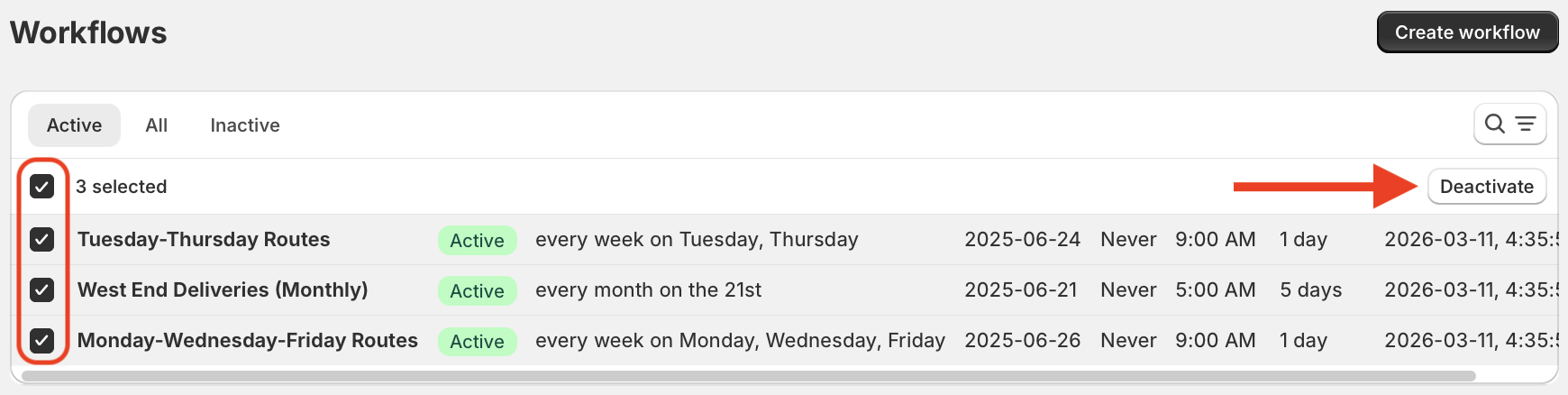
To deactivate multiple workflows at once, from the Active tab of the workflow list, use the checkboxes to select the workflows you'd like to deactivate, and click the Deactivate button that appears in the upper right-hand corner of the table:
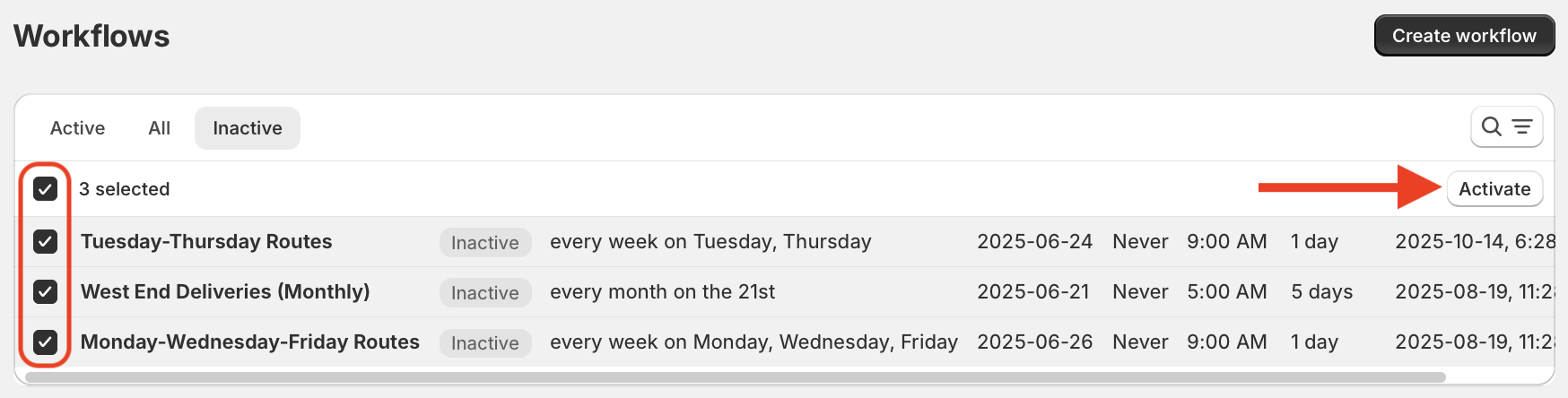
To activate multiple workflows at once, from the Inactive tab of the workflow list, use the checkboxes to select the workflows you'd like to activate, and click the Activate button that appears in the upper right-hand corner of the table:
From any tab within the workflows list, click the name of any workflow to see a history of its recent runs. Access the Actions menu in the upper right-hand corner of the page to edit or activate this specific workflow:

Workflow Visibility
Any routes created by an active workflow will display with a unique indicator at the top of the page when viewing these routes. Hover over this indicator for more details on the specific workflow that generated the route, or click it to jump directly to the workflow's configuration:

In the EasyRoutes Dashboard Activity Feed, routes created by active workflows can be identified by clicking on the bullet for any applicable entries - click the workflow name displayed here to jump directly to the workflow's configuration:

Example Autopilot Workflow Recipes
Example #1: One workflow per delivery zone
If you deliver to set areas, such as a different part of town each day or one driver per area, Autopilot can build a route for each delivery zone for you. There are two ways to set this up.
Option A: A separate workflow for each zone. Best when each zone has its own delivery days, driver or start location.
- Click Create workflow and name the workflow after the zone, for example "North zone, Mondays".
- In Recurring options, set Repeat every to the days you deliver to this zone, and set Create routes before route start time to leave yourself time to review the route.
- Enable Auto-add orders. To limit the route further, select from the Add filter menu, for example a Delivery method filter to include only local delivery orders.
- Enable Skip creating route(s) if no orders match filters, so no empty route is created on days with no orders in this zone.
- Enable the Delivery zones route option and select the zone.
- Optionally, set Start/End Locations to the store or depot that serves this zone.
- To send the route to the same driver every time, open How many routes?, select Create and assign routes to drivers and check that driver. This also unlocks Auto-dispatch, which sends the route to the driver as soon as it's created.
- Click Save, then repeat these steps for each zone.
Option B: One workflow for all zones. Best when every zone is delivered on the same schedule.
- Click Create workflow and set up Recurring options and Auto-add orders as in Option A.
- In How many routes?, set the number of routes to match your number of zones, or select Create and assign routes to drivers and check one driver per zone.
- Select Set custom options for each individual route. On each route's tab, enable Delivery zones and select a different zone.
- Click Save. Each run creates one route per zone, connected in a Route Group.
After saving either option, run a workflow test to check which orders land on each route.
Example #2: One workflow per order tag
If you already sort orders with tags, for example by area or delivery day, Autopilot can use those tags to put each order on the right route. Tags added to orders in Shopify, by hand or with Shopify Flow, sync to EasyRoutes automatically.
- Click Create workflow and name the workflow after the tag.
- In Recurring options, set the schedule for this tag's route. For example, for orders tagged for Thursday delivery, set Repeat every to 1 week and select Thursday.
- Enable Auto-add orders, select Tagged with from the Add filter menu, and select the tag from the list - any tags currently present on your existing orders will be listed here. Tags can be selected with AND logic (where the order must match all selected tags) or OR logic (where the order must match any one of multiple tags applied).
- Enable Skip creating route(s) if no orders match filters.
- Set any other route options you need, such as Start/End Locations, an assigned driver in How many routes?, or Auto-dispatch.
- Click Save, then repeat these steps for each tag.
Entering several tags in one Tagged with filter adds orders that have any of those tags. To route by area and day together, use one tag that combines both (for example, "north-thursday"), or pair the area tag with a delivery date filter if your orders have delivery dates.
This is also the way to repeat the same route every week: tag the orders that belong on it, and the workflow builds the route on schedule. For stops you visit on every route whether or not there's an order, such as a regular pickup, add them to your Address Book and enable Auto-add saved stops.
Frequently Asked Questions
How do I add orders to a route that was auto-created by Autopilot workflows?
Once Autopilot creates a route, it's accessible from the Routes item in your EasyRoutes navigation sidebar - click into the route from there, and access the Add orders tab above the map view to select and add any additional orders to the route. Additional orders can also be added from the Orders page or using custom stops - find more details on all options in this support article.
How do I undo the results of a workflow test run, so I can use those orders on a real, future route?
Orders added to routes created by Autopilot workflows (including test workflow runs) will remain on those routes, and contain the Routed > Has route status as long as they remain on that route. To reset this status, select orders will need to be manually removed from the route that was created, or the route itself can be deleted if all orders it contains need to be reset to the Routed > Not routed status.
Why wasn't a specific order added to a route when Autopilot created it?
This could be due to a number of factors related to the workflow's configuration or timing:
- The Auto-add orders feature automatically adds only unrouted orders - if an order has already been added to an existing route, it will be skipped by Autopilot workflows. Note that this behaviour does not apply to Auto-add saved stops by default, which will add all saved stops that match configured filters, even if they've been added to a previous route. To restrict saved stops to only add when
- Every applied filter must match - if the specific order does not match one or more of the applied filters, it will not be auto-added.
- Orders placed, created, or imported after the route was created by Autopilot aren't auto-added - routes created by a workflow only consider orders that exist when the route is created.
- Orders that are older than the Orders page date window aren't auto-added - this defaults to 60 days, and can be adjusted by following the steps in this support article.
To confirm behaviour related to past Autopilot runs, we recommend accessing the Recent runs table by clicking any workflow's title and checking for any errors or warnings listed there, or running a workflow test to confirm the workflow's behaviour.
Why is my route empty / blank?
This is often intentional to accommodate users that create routes on an automated schedule, and add orders after the fact. It's also possible that no orders matched the filters applied in the auto-add sections - either modify the filters applied here to loosen auto-add restrictions, or enable the Skip creating route(s) if no orders match filters checkbox to skip route creation any time no applicable orders are found.
Why is the Auto-dispatch Route Option disabled for my Autopilot workflow?
The Auto-dispatch Route Option will be disabled (greyed out) unless the workflow is configured to create and assign routes to a specific driver - configure this behaviour from the How many routes? side panel when setting up or editing an Autopilot workflow. More details on how auto-dispatch works can be found in this support article.
Do Autopilot workflows automatically trigger notifications when creating a scheduled route?
To prevent routes that are incomplete or planned far in advance from notifying customers prematurely, creating a route with Autopilot does not currently trigger any notification types. Once the route is created, Scheduled and Rescheduled notifications can be manually triggered when viewing the route itself; Ready for Delivery notifications can be triggered using the same menu, or configured to automatically send when the route is marked as ready - find full details on manually triggering notifications in this support article.